
Introduction
The landscape of artificial intelligence has been reshaped by multimodal models capable of perceiving and reasoning across different forms of data. While Vision-Language Models (VLMs) have captured widespread attention for their ability to "see and understand," a parallel revolution has been unfolding in the audio domain — one that is equally transformative but often receives less public recognition. Automatic Speech Recognition (ASR), once a narrowly scoped technology for voice dictation, has evolved into a foundational pillar of modern multimodal AI.
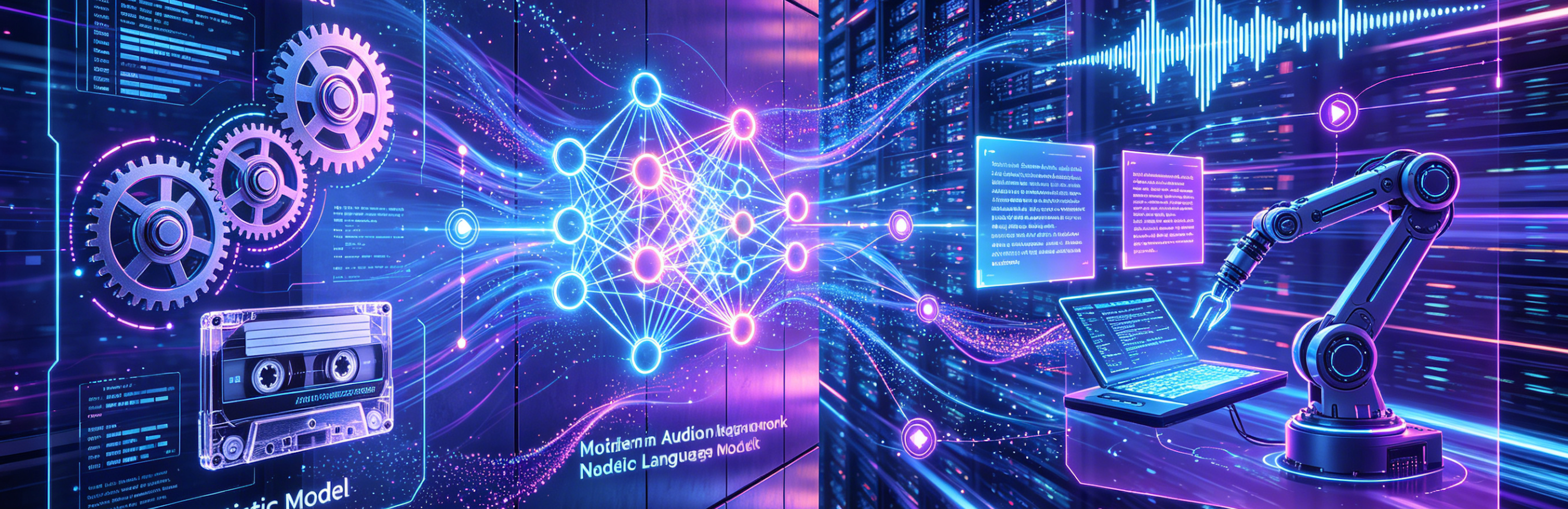
This article explores the technological relationship between VLMs and ASR, traces the historical evolution of ASR from its earliest statistical foundations to today's unified audio-language models like Qwen2-Audio, and examines how these breakthroughs power real-world transcription services such as those offered at videomp3word.com, videomp3word.com/video-to-word, and videomp3word.com/mp3-to-word.
Part 1: The Relationship Between VLMs and ASR — Shared Foundations, Different Modalities
A Common Architectural Blueprint
At their core, VLMs and modern ASR systems share a surprisingly similar architectural DNA. Both are fundamentally sequence-to-sequence problems that map one form of continuous signal into another representation:
| Dimension | Vision-Language Model (VLM) | Audio ASR / Audio-Language Model |
|---|---|---|
| Input modality | Image/video frames | Audio waveform / spectrogram |
| Encoder | Vision Transformer (ViT) | Audio encoder (Conformer / Whisper encoder) |
| Alignment layer | Visual-language projector | Audio-language projector |
| Decoder / Backbone | LLM (e.g., Qwen, LLaMA) | LLM (e.g., Qwen, LLaMA) |
| Output | Text description, answers | Transcribed text, analysis |
Both modalities follow the same three-stage pipeline:
- Perceptual encoding: Raw sensory input (pixels or audio waveforms) is transformed into a dense representation space through a modality-specific encoder.
- Cross-modal alignment: The encoded representation is projected into a shared embedding space that the language model can understand.
- Language generation: A Large Language Model processes the aligned representation alongside text instructions to produce natural language output.
Why This Convergence Matters
The convergence of VLM and ASR architectures represents more than an engineering coincidence — it reflects a deeper truth about how AI perceives the world. Just as VLMs taught machines to "see" through vision encoders, audio-language models teach machines to "hear" through audio encoders. Both systems rely on:
- Self-supervised pre-training on massive unlabeled datasets to learn rich representations
- Instruction fine-tuning to align model outputs with human intent
- A shared LLM backbone that provides reasoning capability across modalities
This architectural unification means that advances in one modality often benefit the other. Techniques like rotary position embeddings, flash attention, and direct preference optimization (DPO), originally developed for text models, now power both VLMs and audio models simultaneously.
Part 2: The Historical Evolution of ASR — A Six-Decade Journey
Era 1: The Statistical Foundation (1950s–1980s)
The earliest ASR systems were rudimentary by today's standards. Bell Labs' "Audrey" (1952) could recognize single digits spoken by a single speaker with approximately 90% accuracy. These systems relied on template matching — comparing incoming audio against pre-recorded reference patterns.
The breakthrough came with Hidden Markov Models (HMMs) combined with Gaussian Mixture Models (GMMs) in the 1970s and 1980s. The GMM-HMM framework modeled speech as a stochastic process where:
- HMMs captured the temporal dynamics of phoneme sequences
- GMMs modeled the acoustic observation probabilities
This era produced the first commercially viable speech recognition systems, including IBM's "Shoebox" and Dragon Dictate. However, GMM-HMM systems required enormous amounts of hand-engineered features and struggled with speaker variability, noise, and out-of-vocabulary words.
Era 2: The Deep Learning Revolution (2006–2015)
The introduction of Deep Neural Networks (DNNs) as acoustic models marked a paradigm shift. In 2006, Hinton and colleagues demonstrated that deep belief networks could significantly outperform GMMs on phone recognition tasks. By 2010–2012, major industry players (Google, Microsoft, IBM) had replaced GMM acoustic models with DNNs, achieving 20–30% relative error reduction overnight.
Key innovations during this era:
- DNN-HMM hybrid systems: Neural networks predicted senone (sub-phoneme) posteriors, while HMMs maintained temporal structure
- Convolutional Neural Networks (CNNs) for speech: Applied to spectrogram inputs to capture local spectral patterns
- Recurrent Neural Networks (RNNs): LSTM and GRU architectures modeled temporal dependencies explicitly, eliminating the Markov assumption's limitations
Era 3: The End-to-End Era (2015–2020)
The most dramatic transformation came when researchers replaced the entire GMM-HMM-DNN pipeline with end-to-end neural architectures that mapped audio directly to text:
- Listen, Attend and Spell (LAS, 2015): Introduced the encoder-decoder-attention architecture for ASR. The encoder processed audio features, an attention mechanism focused on relevant segments, and a decoder generated character sequences.
- Connectionist Temporal Classification (CTC): Enabled training without frame-level alignment labels, dramatically simplifying the training pipeline.
- RNN-Transducer (RNN-T, 2012/2018): Combined CTC and attention-like prediction, becoming the backbone of production ASR systems like Google's Voice Search.
- Transformer-based ASR (2019): Replaced RNNs with self-attention mechanisms, enabling parallel training and superior modeling of long-range dependencies.
- Conformer (2020): Combined convolutional layers (for local feature extraction) with Transformer self-attention (for global context), becoming the dominant architecture for production ASR.
Era 4: The Foundational Model Era (2022–Present)
The release of OpenAI's Whisper (2022) represented a watershed moment. Trained on 680,000 hours of multilingual, multitask supervised data, Whisper demonstrated that:
- Massive scale in training data could dramatically improve robustness to accents, noise, and domain shifts
- A single model could handle transcription, translation, language identification, and voice activity detection
- Zero-shot generalization to new languages and domains was achievable
Whisper's success catalyzed a wave of audio foundation models and audio-language models that treat audio understanding as a multimodal reasoning task rather than a narrow transcription problem.
Part 3: Qwen-Audio and Qwen2-Audio — Major Breakthroughs in Audio-Language Modeling
Qwen-Audio (August 2023): The First Step
Qwen-Audio, developed by Alibaba Cloud's Tongyi Lab, was among the first open-source large audio-language models. Its key innovations included:
Hierarchical Audio Encoder: The model employed a multi-stage encoding approach:
- A Whisper-large encoder extracted frame-level acoustic features
- An additional audio adapter projected these features into the LLM embedding space
- This hierarchical design preserved fine-grained acoustic detail while enabling high-level semantic reasoning
Unified Multi-Task Training: Qwen-Audio was trained on diverse audio tasks simultaneously — speech recognition, audio description, music understanding, and environmental sound classification — all within a single model, using natural language prompts rather than rigid task identifiers.
Benchmark Achievement: At the time of release, Qwen-Audio achieved state-of-the-art results across multiple benchmarks including CoVoST2, Common Voice, and LibriSpeech, while supporting both English and Chinese.
Qwen2-Audio (July 2024): The Next Leap
Qwen2-Audio introduced several transformative improvements over its predecessor:
Dual Interaction Modes: The model supports two fundamentally different ways of interacting with audio:
| Mode | Description | Practical Use Case |
|---|---|---|
| Voice Chat | Direct voice-to-voice interaction without intermediate ASR | Conversational AI, voice assistants |
| Audio Analysis | Audio + text instruction input for deep analysis | Transcription, audio forensics, content analysis |
Simplified Pre-Training Pipeline: Qwen2-Audio eliminated the complex hierarchical tag system used in Qwen-Audio, replacing it with natural language prompts for all data and tasks. This simplification:
- Reduced training complexity
- Improved the model's ability to generalize to novel task formulations
- Made the system more robust to out-of-distribution inputs
Expanded Data Scale and Diversity: The training corpus was significantly expanded in both volume and diversity, covering:
- Speech data across 8+ languages and dialects (English, Chinese, Cantonese, French, Italian, Spanish, German, Japanese)
- Environmental sounds, music, and multi-speaker conversations
- Instruction-following data for audio-centric reasoning tasks
DPO Alignment: Direct Preference Optimization was applied to improve factuality, instruction adherence, and response quality — a technique originally developed for text LLMs that proved equally effective for audio models.
AIR-Bench Dominance: Qwen2-Audio outperformed previous state-of-the-art models, including Gemini 1.5 Pro, on audio-centric instruction-following benchmarks.
Architectural Innovation: The Audio-Language Alignment
The core technical innovation of the Qwen audio models lies in their audio-language alignment strategy. Rather than training a standalone ASR system followed by a language model (the traditional cascaded approach), Qwen-Audio and Qwen2-Audio use an end-to-end audio-language architecture:
Audio Waveform → Audio Encoder → Audio-Language Projector → LLM Backbone → Text Output
This unified approach eliminates the error propagation inherent in cascaded systems, where mistakes made by the ASR module are irreversible and compound downstream. In the unified architecture, the LLM can reason over raw acoustic features, enabling:
- Contextual correction: The LLM uses semantic context to resolve ambiguities in the acoustic signal
- Implicit noise robustness: The model learns to ignore noise patterns that would confuse a standalone ASR system
- Multi-task flexibility: A single model handles transcription, summarization, sentiment analysis, and Q&A about audio content
Part 4: How ASR Breakthroughs Power Modern Transcription Services
Services like videomp3word.com, which offers video-to-word and mp3-to-word conversion capabilities, benefit directly from every major breakthrough in the ASR evolution. Here is how each advancement translates to real-world features:
1. From GMM-HMM to Deep Neural Networks: Accuracy at Scale
The shift from statistical models to neural acoustic models delivered the first quantum leap in transcription accuracy. For a service processing diverse video and audio content, this means:
- Higher word accuracy rates across varied speaking styles, accents, and recording conditions
- Reduced post-editing burden for users who need precise transcripts
- Scalable processing — neural models can be optimized for GPU inference, enabling rapid turnaround for large media files
2. End-to-End Architecture (CTC, LAS, RNN-T): Simplicity and Speed
End-to-end ASR models eliminated the complex multi-component pipelines of earlier systems. For transcription services, this translates to:
- Faster processing pipelines with fewer components to maintain and optimize
- Direct character/word output without intermediate phoneme representations
- Streaming capability — RNN-T and similar architectures support real-time transcription, enabling live video captioning and meeting transcription
3. Conformer Architecture: Best of Both Worlds
The Conformer's hybrid convolutional-attention design specifically benefits services handling mixed-content audio:
- Local feature sensitivity captures phoneme-level details critical for accurate transcription
- Global context modeling resolves ambiguities using sentence-level semantics
- Robustness to noise and overlapping speech — critical for video content where background music, sound effects, and multiple speakers coexist
This directly enhances the quality of transcripts produced through videomp3word.com/video-to-word, where video audio often contains complex acoustic environments.
4. Whisper-Scale Foundation Models: Multilingual and Zero-Shot Capability
The foundation model paradigm delivers capabilities that were previously impossible:
- Multilingual transcription from a single model — no need to detect language and route to language-specific pipelines
- Zero-shot domain adaptation — the model transcribes specialized content (lectures, technical presentations, interviews) without domain-specific fine-tuning
- Noise robustness — models trained on hundreds of thousands of hours generalize well to real-world audio quality variations
- Implicit punctuation and capitalization — the model produces properly formatted text without post-processing
5. Audio-Language Models (Qwen-Audio, Qwen2-Audio): Beyond Transcription
The latest generation of audio-language models enables features that go far beyond simple word-for-word transcription:
| Feature | Traditional ASR | Audio-Language Model |
|---|---|---|
| Transcription | ✓ | ✓ (often more accurate) |
| Speaker identification | Requires separate system | Built-in capability |
| Sentiment/tone analysis | Not possible | Native understanding |
| Summarization | Requires separate NLP pipeline | Native capability |
| Q&A about audio content | Not possible | Direct support |
| Multi-modal instructions | Not supported | Audio + text input |
For users of videomp3word.com/mp3-to-word, these capabilities mean that the service can evolve from simple transcription to comprehensive audio intelligence — not just converting speech to text, but understanding, analyzing, and summarizing audio content in a single pipeline.
6. DPO Alignment: Factuality and Reliability
The application of Direct Preference Optimization to audio models specifically addresses a critical concern for transcription services:
- Reduced hallucination: The model is less likely to "invent" words or phrases that were not spoken
- Consistent formatting: Outputs follow predictable conventions for timestamps, speaker labels, and punctuation
- Faithful representation: The transcript accurately reflects the original audio content without embellishment or omission
Part 5: Looking Forward — Where VLM and ASR Converge
The most exciting frontier lies in omni-modal models that integrate vision, audio, and language within a single architecture. Qwen2-Omni and Qwen3.5-Omni represent this direction — models that can simultaneously process video frames and audio tracks, understanding the relationship between what is seen and what is heard.
For transcription and content analysis services, this convergence means:
- Visual context enrichment: Lip-reading from video frames can disambiguate audio transcription in noisy conditions
- Speaker diarization from video: Visual speaker identification combined with audio analysis
- Temporal alignment: Synchronizing transcribed text with visual events in video content
- Multimodal summarization: Generating summaries that reference both visual and audio content
Services like videomp3word.com that already handle both video and audio inputs are uniquely positioned to leverage these omni-modal capabilities as they mature. The video-to-word pipeline, in particular, stands to benefit enormously from models that jointly reason over visual and audio modalities rather than treating them independently.
Conclusion
The evolution of ASR from template-matching systems to unified audio-language models represents one of the most dramatic progressions in AI history. Each generation — from GMM-HMM to deep neural networks, from end-to-end architectures to foundation models, and now to instruction-following audio-language models — has expanded the boundaries of what is possible in audio understanding.
The architectural convergence between VLMs and ASR is not coincidental; it reflects the emergence of a general-purpose multimodal AI paradigm where the same underlying principles — perceptual encoding, cross-modal alignment, and language-based reasoning — apply across all sensory modalities.
For transcription services and content analysis platforms, these advances translate directly into higher accuracy, broader language support, deeper content understanding, and entirely new capabilities that were inconceivable just a few years ago. As audio-language models continue to improve, the gap between hearing and understanding — between transcribing words and comprehending meaning — continues to narrow.
For professional video-to-text and audio-to-text transcription powered by state-of-the-art AI models, visit videomp3word.com. Try our video-to-word converter for video content or our mp3-to-word service for audio files.